
Five days in the Magaliesberg, in a cohort of ten, with a physician who has spent thirty years understanding sleep. Every element — when you wake, when you eat, when you exercise, how you wind down — is set around your chronotype and your data. Not a group programme with your name on it.
Sleep is the single biggest lever on cognitive performance, executive function and physical recovery — and almost no high-performer is using it properly. This retreat gives you back the twenty percent of bandwidth your sleep has been quietly taxing.
Sleep architecture restored, decision-making bandwidth recovered. You leave the week thinking — and judging — more clearly than you have in years.
Physical and mental recovery happens during sleep. Optimised sleep is optimised recovery — from training, travel, and the daily load of the work you've chosen to do.
Not a short-term fix. A written, evidence-based protocol you own and use for life, backed by the data that shows you what changed during the week.
Your peers are not sleeping properly. You will be. The compounding advantage of an actually-restorative night, every night, is difficult to overstate.
By the time you check in, the clinical team already knows you. They know your chronotype, your sleep history, your habits — and they have two weeks of your actual sleep data sitting on the desk.
The retreat runs two tracks at once — the shared programme (what we do together) and the personalised programme (times set individually by chronotype). Times marked variable differ by participant.
14:00 check-in. Actigraphy collected and downloaded. 30–45 min arrival consult — the first time we look at your data together. Personal schedule confirmed. Communal dinner. Welcome session.
Morning walk in natural light. First full day on the protocol. Morning group session. Daily 30-min consult. Evening masterclass: Normal Sleep.
Protocol adjusted against last night's data. Cognitive component of insomnia addressed. Evening masterclass: Dysfunctional Beliefs About Sleep.
Sleep aids, supplements, alcohol, CBD — what the evidence says. Evening masterclass: Sleep Aids. Lifestyle levers covered the following day.
Personalised review of your week's data. Your protocol, finalised. Your relapse plan. Evening masterclass: Taking Your Learnings Into Daily Life. Friday morning departure.
The five evening masterclasses — Normal Sleep · Dysfunctional Beliefs · Sleep Aids · Sleep & Lifestyle · Taking Your Learnings — are the formal teaching spine of the week. Content is shaped around the five personal sleep questions every participant submits pre-retreat.
The schedule below is the repeating structure for Days 2–5. The shared anchors are fixed; your wake, exercise, breakfast and wind-down are calibrated to your chronotype.
Larks wake on a light timer between 5:30 and 7:00 and exercise in the morning. Owls wake between 8:00 and 9:00 with an eye mask and tablet alarm; exercise comes later in the day. Breakfast is yours, when your biology says so.
Actigraphy watches downloaded. Clinical team reviews your overnight data. 09:00–10:00 morning group session: how last night went, what worked, what didn't, brief clinical commentary. 10:00–11:00 communal walk in natural sunlight — circadian intervention, not "an activity."
Free time inside your peak cognitive window, plus your daily 30-minute one-to-one consult with the clinical team (you book your preferred slot via tablet). Spa, gym, work, walks, the pool, painting, an off-site activity — your day. Communal lunch 12:30–13:30. No daytime napping.
Owl exercise window. Circadian-aligned exercise is a clinical component, not optional. Choose from cycling, running, walking, weights or yoga as confirmed in your pre-retreat questionnaire.
Communal dinner, fixed time — the daily anchor. 20:00–21:00 evening masterclass, one of the five formal teaching sessions. 21:00 fire and lounge time. Owls continue in the upstairs private lounge until their wind-down.
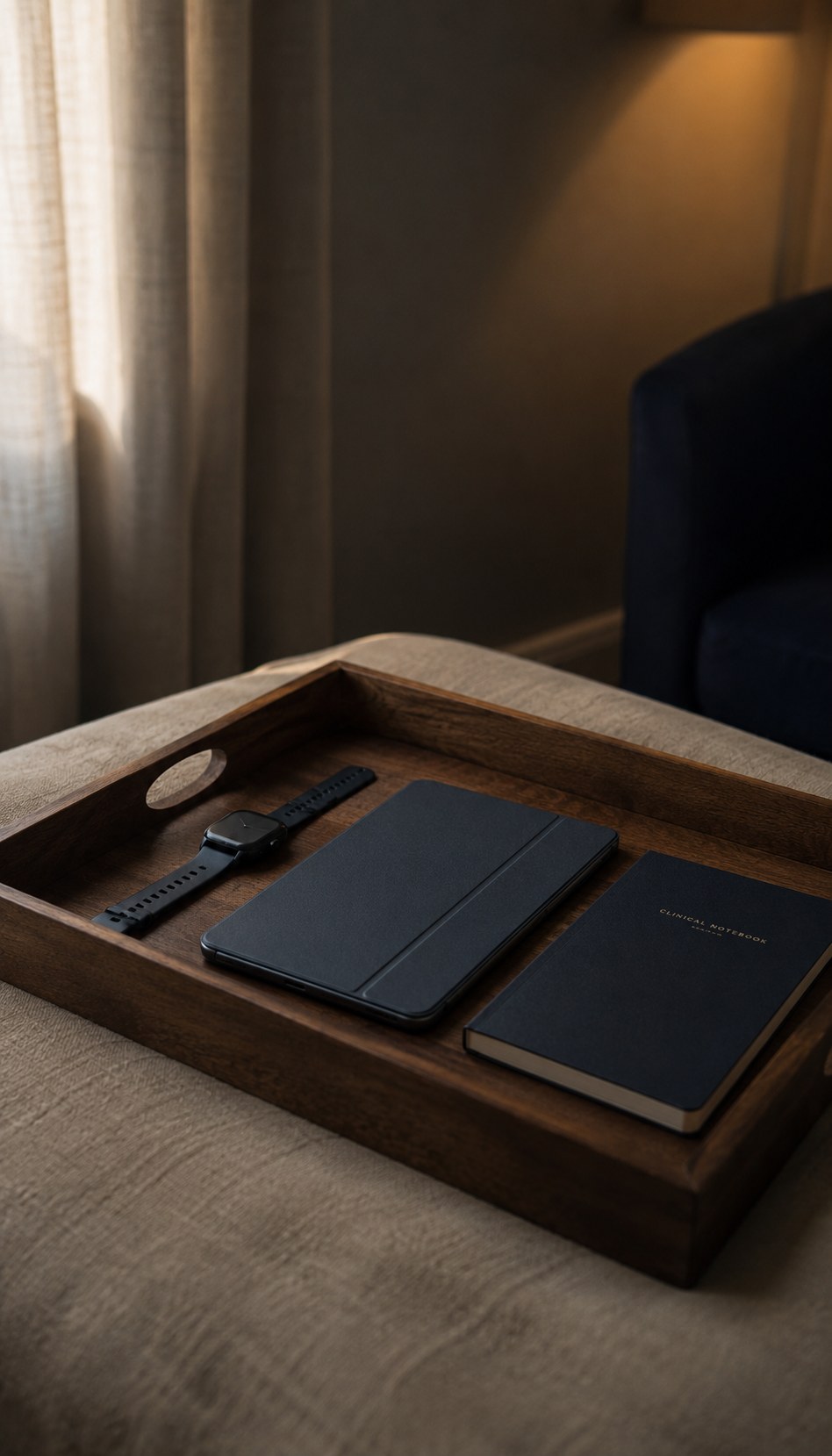
Thirty minutes before your prescribed bedtime, your tablet sends you back to your chalet. Warm lamp on. Phone in its bed. Tablet shows tonight's wind-down activity from a curated menu. Room cooled to 18–20°C. Lights off.
Personalisation is the clinical and experiential core of the programme. Every participant should feel the retreat was built around them — because it was.
Larks (5:30–7:00 wake, morning exercise) or owls (8:00–9:00 wake, late-afternoon exercise). Assigned by the clinical team after your questionnaire and pre-retreat consult.
Prescribed wake time and bedtime set on CBT-I principles, calibrated to your actual sleep need from your two weeks of pre-retreat actigraphy.
Time of day set by chronotype. Type — cycling, running, walking, weights, yoga — set by your preference in the questionnaire.
Breakfast timing follows your chronotype; lunch and dinner are communal. The menu is informed by sleep-optimisation principles — and your dietary preferences.
Selected nightly by you from a rotating menu — breath work, body scan, guided meditation, audio sleep story, audiobook, physical book, adult colouring. We track which works best for you.
Lark chalets pre-set with a light timer. Owl chalets pre-set with the eye mask and tablet alarm. Room temperature schedule coordinated daily with the La Joya facilities team.
The clinical core of the programme is Cognitive Behavioural Therapy for Insomnia — the evidence-based first-line treatment for chronic sleep problems. It is not delivered as a course. It is delivered as your week.
The retreat does not end at the gate. Within seven days, every participant receives a comprehensive personalised report — your data, your protocol, your beliefs reframed, and the pathway ahead.
How your sleep changed across the five nights, compared with your pre-retreat baseline. The objective record of what shifted.
Your prescribed wake time, bedtime, sleep window, and how to adjust them for travel, season and disruption. The plan you own.
Which activity correlated with your best overnight outcomes during the week — and which to fall back on when you need to.
The chronotype-aligned exercise window and meal timing notes that matched your best nights.
The dysfunctional beliefs about sleep we identified during the week, and their evidence-based reframes — written down so they keep working when you forget them.
What to do when sleep deteriorates. A two-week telemedicine follow-up is scheduled. If a sleep disorder was identified, you have a direct pathway into the Sleep Health Centre clinic.
The retreat is led by physicians from Sleep Health Centre — a clinical practice with decades of accumulated experience in sleep medicine.

South Africa's foremost sleep specialist, with three decades of clinical and research experience. The physician who trains the sleep doctors — not a wellness coach, not a sleep facilitator. Leads the protocol design and the morning group sessions.

Co-facilitator on the retreat and operational lead for the programme. Focused on integrating clinical diagnostics, environmental design and behavioural protocols into plans participants can actually live with after they leave.
Each day has a clinical purpose, but only a few scheduled anchors — actigraphy download, morning group session, communal walk, communal lunch and dinner, evening masterclass, your daily 30-minute consult. The rest is genuinely yours.
Your tablet is a tool, not a device. It holds your personalised schedule, your wind-down activity menu, your meal ordering, your daily sleep diary, your guided wind-down content, and emergency call capability. No social media. No general internet. No news. Actigraphy data is not shown to you on the tablet — that conversation happens with the clinician.
Your phone goes to bed before you do. There is a designated phone bed in your chalet, on the far side of the room near a charging point. You put it there at wind-down and leave it. The reason is simple — your nervous system cannot distinguish between a notification and a threat. We remove that signal from your sleep environment for five nights so you can feel the difference.
Bring everything you are taking, including sleep aids. The clinical team will assess what to keep, what to adjust, and what to taper — in conversation with you and, where relevant, your treating doctor. Withdrawal from sleeping tablets is something we are explicitly equipped to support, via CBT-I.
The retreat is a closed cohort of ten — partners cannot join the programme. Companion arrangements outside the programme can be discussed on enquiry; we will tell you honestly if it is workable for the cohort you are looking at.
You have a direct pathway into the Sleep Health Centre clinic for ongoing care — diagnostic confirmation, treatment programmes, CPAP, the lot. No other retreat in South Africa offers this clinical continuity.